Introduction: The Escalating Cyber War & The Need for Smarter Defenses
Cyber threats are moving faster than ever. Security teams face a tidal wave of advanced attacks. These include stealthy advanced persistent threats (APTs), unknown zero-day exploits, shape-shifting polymorphic malware, and dangerous insider risks. Traditional, rule-based security tools and human analysts alone cannot keep up. This leads to alert fatigue and team burnout as defenders are overwhelmed by sheer volume and complexity.
The solution is AI threat detection. This next-generation approach uses artificial intelligence, machine learning, and behavioral analytics. It automatically finds threats faster and more accurately than old methods. AI threat detection works by analyzing patterns in network traffic, user behavior, and system activity to spot anomalies in real time.
This post will explain how machine learning security acts as the engine for this intelligent detection. We will also show how it enables automated threat response. Together, they create a proactive and resilient security posture for the modern digital battlefield.
The Engine Room: Understanding Machine Learning Security
At the core of intelligent cyber defense is machine learning security. This is the application of ML models to security data. It allows systems to learn what "normal" looks like for your environment. Then, they can automatically flag suspicious deviations. Think of it as the "brain" that powers AI threat detection.
How Machine Learning Powers AI Detection
ML models are trained on massive datasets. This includes historical logs, network flows, endpoint telemetry, and examples of known attacks. By processing this data, the models learn patterns of both safe and malicious activity. They continuously refine their detection logic over time by learning from new, real-time data. This constant learning is key to staying ahead of threats.
The Critical Shift from Signatures to Behavior
This is a major leap from traditional tools. Signature-based detection relies on known fingerprints of past malware. It can only catch threats that have been seen and cataloged before. Machine learning security, however, focuses on behavior and patterns. This enables the discovery of novel attacks, including zero-day exploits and new malware variants that have no existing signature.
Key Machine Learning Techniques Simplified
Supervised Learning: Models are trained on labeled data—like "this is malware" or "this is safe." They learn to recognize known threat types and can classify them at massive scale and speed.
Unsupervised Learning: Models establish a baseline of normal activity without pre-existing labels. They then flag significant anomalies. This is crucial for detecting never-before-seen attacks and insider threats.
Deep Learning: A more complex subset of ML, deep learning is excellent for analyzing intricate patterns within files, code, or user behavior sequences.
AI Threat Detection in Action: From Data to Alerts
Understanding the theory is one thing. Seeing how AI threat detection operates in practice is another. Let's walk through the step-by-step pipeline.
Step 1: Data Ingestion from Every Corner
The system continuously feeds on data from across your entire digital estate. This includes:
Network traffic and flow data.
Endpoint agents (EDR/XDR telemetry).
Cloud platform activity logs.
User authentication and identity logs.
External threat intelligence feeds.
This comprehensive visibility is the fuel for AI analysis.
Step 2: Behavioral Baselining & Analysis
The AI builds a dynamic, evolving profile of "normal" for every user, device, and application. It learns typical login times, standard data access patterns, usual network connections, and more. This user and entity behavior analytics (UEBA) approach means the system knows when something is out of the ordinary.
Step 3: Anomaly Scoring & Correlation
Not every anomaly is a threat. The AI scores each event based on its risk level. Most importantly, it correlates weak, seemingly unrelated signals from different data sources. A strange login from a new country might be a false alarm. But if it happens just before a massive data download attempt, correlation reveals a high-confidence threat. This cross-domain correlation is what drastically reduces false alarms.
Concrete Threat Examples
Zero-Day Exploit: An attacker uses a previously unknown vulnerability. No signature exists. However, the AI detects unusual process spawning and unexpected outbound connections from a compromised endpoint, flagging the attack immediately.
Insider Threat: A user account begins downloading gigabytes of sensitive intellectual property at 3 AM from an unusual location. The AI flags this massive deviation from their normal behavior pattern.
Ransomware: The AI detects rapid, suspicious file encryption patterns on a workstation. It correlates this with calls to known malicious domains and automatically isolates the system before the ransomware can spread.
The Tangible Benefits of AI-Powered Detection
Speed: Real-time analysis slashes detection time from days or hours to minutes or seconds.
Scale: AI can process terabytes of data across hybrid and cloud environments—a task impossible for human teams.
Accuracy: Advanced correlation and pattern recognition filter out noise, reducing false positives and alert fatigue.
Coverage: The behavioral focus catches stealthy, low-and-slow attacks like APTs, lateral movement, and data exfiltration that evade traditional tools.
Closing the Loop: The Power of Automated Threat Response
Detection is only half the battle. The time between discovery and action is when damage occurs. This is where automated threat response becomes non-negotiable. It is the system's ability to execute immediate, predefined actions upon a high-confidence threat detection.
Human response times are often too slow. Automation drastically reduces the Mean Time to Respond (MTTR) and cuts attacker dwell time. By automating repetitive containment tasks, you ensure a consistent, lightning-fast reaction.
Examples of Automated Actions
Endpoint Response: Isolate an infected device from the network, kill malicious processes, or roll back system changes.
Network Response: Block a malicious IP address or domain at the firewall or secure web gateway.
Identity Response: Force a password reset, revoke access tokens, or temporarily lock a compromised user account.
Data/Content Response: Quarantine a malicious file attached to an email or block a phishing message from reaching the inbox.
SOC Workflow Automation: Open and pre-populate an incident ticket with rich context, then notify the relevant security analyst for review.
The Role of Human Oversight
Automation is governed by policy. Organizations set rules based on their risk tolerance. High-confidence, high-severity threats (like ransomware) can be auto-contained. Lower-confidence alerts can be escalated for human investigation. This creates a powerful, collaborative human-machine team.
The Integrated Advantage: Building an AI-Powered Security Ecosystem
The true power lies in integrating these three concepts into a seamless, continuous loop.
AI Threat Detection constantly monitors and finds suspicious behavior.
Machine Learning Security provides the intelligence, learning from data to refine detection and reduce noise.
Automated Threat Response takes high-confidence detections and turns them into immediate action.
This integrated loop delivers transformational outcomes:
Drastically Reduced Dwell Time: Attackers have less time to move laterally, escalate privileges, or exfiltrate data.
Elevated Human Analysts: Security teams are freed from alert fatigue. They can shift focus from repetitive triage to strategic threat hunting, complex investigation, and improving security posture.
Proactive Security Posture: AI can identify early-stage attack indicators and vulnerable patterns. This allows teams to harden defenses before a full-blown incident occurs.
This AI-powered ecosystem is now embedded within modern security platforms like EDR/XDR, SIEMs, and cloud security tools, creating a unified, intelligent defense fabric.
Considerations, Challenges, and The Road Ahead
While powerful, AI-driven security is not a magic bullet. Successful implementation requires awareness of its challenges.
Key Implementation Challenges
Data Dependency: The accuracy of ML models depends entirely on the quality and comprehensiveness of the data they are fed. Biased, incomplete, or poor-quality data creates dangerous blind spots.
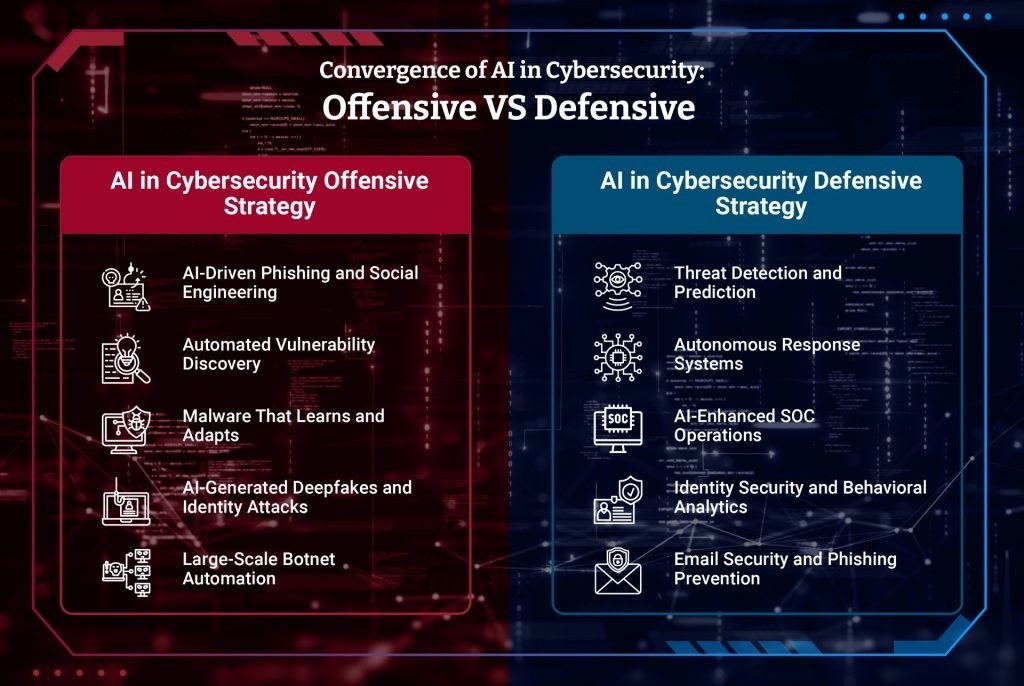
Adversarial AI: The cybersecurity landscape is becoming an "AI vs. AI" battleground. Attackers are using artificial intelligence to create evasive malware, launch sophisticated phishing campaigns, and even conduct adversarial attacks designed to fool security ML models.
The Essential Role of Humans: The AI-Assisted SOC
AI will not replace security analysts. Instead, it augments them in an "AI-Assisted SOC" model.
AI handles: High-volume data processing, initial alert correlation, routine containment tasks, and pattern recognition at scale.
Humans provide: Strategic oversight, complex investigation, ethical judgment, exception handling, and continuous improvement of playbooks and policies.
The Final Word
The evolution of cyber threats is relentless. Given the scale, speed, and sophistication of modern attacks, AI-powered threat detection and automated response are transitioning from a competitive advantage to a fundamental necessity for effective cyber defense.
Organizations that proactively integrate these technologies—building strong machine learning security foundations and governed automated threat response playbooks—will not just keep pace. They will build a more resilient, adaptive, and proactive security posture ready for the future of cybersecurity.
References
https://redcanary.com/cybersecurity-101/security-operations/ai-threat-detection/
https://www.sentinelone.com/cybersecurity-101/data-and-ai/ai-threat-detection/
https://www.proofpoint.com/us/threat-reference/ai-threat-detection
https://corelight.com/resources/glossary/ai-threat-detection
https://www.paloaltonetworks.com/cyberpedia/ai-in-threat-detection