Introduction: The Critical Choice in Modern Cybersecurity
In today’s cybersecurity environment, advanced threats like ransomware and sophisticated, multi-vector attacks demand robust detection and response tools. These threats can hit from any angle—email, cloud apps, networks, and devices. This dangerous landscape makes the central debate for security teams more critical than ever: choosing between EDR vs XDR.
This post will demystify both Endpoint Detection and Response (EDR) and Extended Detection and Response (XDR). We will provide a detailed, head-to-head comparison and offer practical guidance to help you select the right solution for your organization’s strategy.
The Foundation - What is EDR (Endpoint Detection and Response)?
Endpoint Detection and Response (EDR) is a security solution focused exclusively on protecting endpoints. Endpoints are the devices where users and data connect. This includes laptops, servers, desktops, and mobile phones.
At its core, EDR provides continuous monitoring and deep visibility into all activities on these endpoint devices. It doesn’t just log events; it analyzes behavior to find threats that traditional antivirus might miss.
Key Capabilities of Endpoint Detection and Response
EDR platforms are built around three powerful functions:
Threat Detection: EDR uses behavioral analysis and threat intelligence to identify suspicious activity and malware in real-time. Instead of just looking for known bad files, it watches for unusual actions, like a process trying to encrypt dozens of files rapidly (a sign of ransomware).
Investigation & Forensics: If a threat is detected, EDR allows security teams to search through historical endpoint data. Analysts can investigate incidents and determine the root cause. They can see what files were touched, what registry changes were made, and what network connections were established.
Automated Response: EDR can take immediate action on the endpoint itself to contain a threat. This includes isolating a compromised device from the network, terminating malicious processes, or deleting malicious files.
Primary Use Case and Strength
Endpoint detection response excels at endpoint-centric security tasks. Its deep visibility makes it perfect for:
Detecting insider threats from within the network.
Tracking detailed file executions and registry changes.
Containing localized breaches like ransomware on a specific device or server.
In short, EDR is your expert specialist for everything that happens on your computers and servers.
The Evolution - What is XDR (Extended Detection and Response)?
Extended Detection and Response (XDR) is the evolution of EDR. It integrates and correlates data from multiple security layers beyond just endpoints. Think of XDR as EDR with a much wider lens.
The core premise of XDR is breaking down security silos. It collects and analyzes telemetry from endpoints, networks, cloud workloads, email servers, identity systems, and applications. This gives a unified view of your entire digital estate.
Key Capabilities of Extended Detection and Response
XDR enhances security operations through integration:
Unified Visibility: XDR provides a single, holistic console showing threats across your entire IT environment. You don’t need to jump between your email security dashboard, your cloud security tool, and your EDR console.
Cross-Domain Correlation: This is the superpower of XDR. It connects related events from different sources. For example, it can link a phishing email (from your email security), a malicious download to a cloud storage app (from your cloud security), and the execution of that file on an endpoint (from your EDR). This reveals complex, multi-stage attacks that single-point solutions would miss.
Orchestrated Response: XDR enables automated response actions that span different systems. Instead of just isolating an endpoint, it can block a malicious IP at the firewall, disable a compromised user account in Active Directory, and quarantine the malicious email—all from one playbook.
Technology and Core Benefit
Both EDR and XDR use artificial intelligence (AI) and machine learning for real-time monitoring. However, XDR’s primary advantage is its ability to reduce alert fatigue and noise. By correlating data from many sources into a central console, XDR provides higher-fidelity, more actionable alerts. This means your security team spends less time chasing false positives and more time stopping real breaches.
Head-to-Head Comparison - EDR vs XDR
Understanding the individual tools is key, but a true comparison of EDR vs XDR highlights their differences. This detailed breakdown will help you see which aligns with your needs.
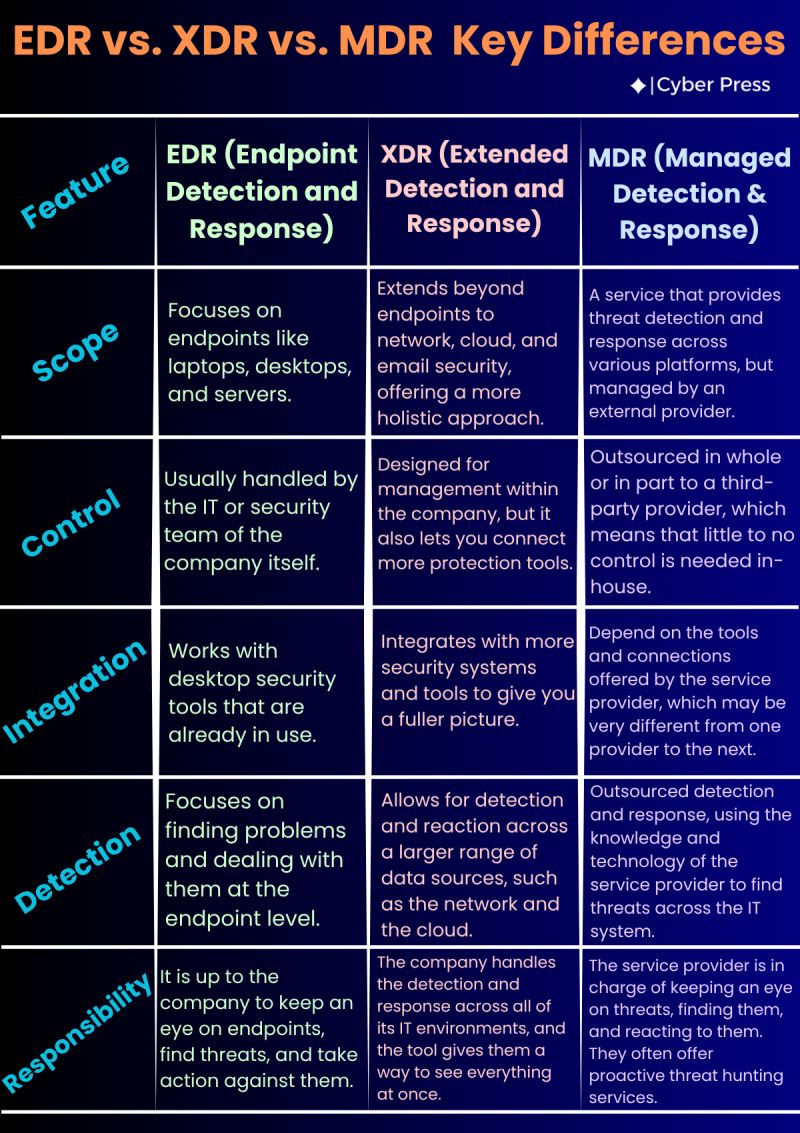
1. Scope & Data Sources
EDR: The scope of an EDR solution is limited to endpoint devices like laptops, servers, and desktops. Its visibility is incredibly deep but narrow, focused solely on host-based activity.
XDR: The scope of XDR is extended. It ingests data from endpoints, network traffic, cloud environments (like AWS, Azure), email platforms (like Microsoft 365), identity services, and more. It provides broad, integrated visibility across your entire attack surface.
2. Visibility & Context
EDR: Offers deep forensic visibility into endpoint behavior. It is perfect for understanding what happened on a specific machine—every process, every file change, every network call. This is crucial for detailed incident response on a device.
XDR: Provides contextual visibility across domains. It shows how an attack moved through your environment—from a phishing email, to a network lateral movement, to a cloud app compromise, and finally to an endpoint. This context is vital for understanding the full scope of a breach.
3. Threat Detection & Investigation
EDR: Exceptionally strong at detecting endpoint-focused malware, exploits, and insider threats. Its investigation is powerful but confined to the endpoint data. You get a deep dive into one device.
XDR: Superior at detecting sophisticated, multi-vector attacks like supply chain compromises or business email compromise (BEC) that touch multiple systems. Investigation is streamlined because the data from email, cloud, and network is already pre-correlated in one timeline.
4. Response Automation
EDR: Automates response actions localized to the endpoint. This includes terminating malicious processes, isolating the device, or deleting files. The response is effective but contained to that single host.
XDR: Orchestrates coordinated response across the entire security stack. A single incident can trigger a playbook that blocks a malicious URL at the firewall, quarantines the phishing email for all users, and revokes the compromised user’s session—stopping the attack at multiple choke points.
5. Operational Efficiency
EDR: Can lead to alert fatigue and operational silos. Security teams must juggle the EDR console alongside their email security dashboard, cloud security tool, and network monitoring system. This context-switching slows down response.
XDR: A unified console reduces tool sprawl. By correlating alerts from different sources into high-fidelity incidents, it dramatically decreases alert fatigue. This improves analyst efficiency, reduces mean time to respond (MTTR), and allows teams to scale their operations.
6. Implementation & Complexity
EDR: Generally simpler to deploy as a standalone solution focused on one layer (endpoints). You install agents on your devices and manage the platform.
XDR: Requires broader integration with existing tools (like your SIEM, firewall, or identity provider) but results in unified management. The initial setup may be more involved, but it simplifies long-term operations.
Summary of the Relationship
It’s crucial to understand that XDR builds on EDR as a natural extension. XDR often incorporates a powerful EDR component as its endpoint sensor. The key difference is that XDR takes that endpoint data and enriches it with context from everywhere else. This integration offers enhanced visibility, faster detection of complex attacks, and better adaptability for modern, hybrid IT environments.
Decision Guide - How to Choose Between EDR and XDR
The choice in the EDR vs XDR debate isn’t about which technology is universally "better." It’s about which is the right fit for your organization’s specific needs, maturity, and threat landscape.
Scenario 1: When EDR Might Be the Right Fit
An endpoint detection response solution could be the ideal choice if:
Your primary concern is securing endpoints. For example, companies with a large remote workforce using company laptops.
You have limited security resources or budgets. EDR provides a focused, highly effective solution for the most common attack vector without the complexity of a full platform.
You have strict regulatory compliance requirements that mandate specific endpoint controls and detailed forensic logging.
You are satisfied with your existing, non-endpoint security tools (like firewalls, SIEM, email security) and simply want to add a best-of-breed endpoint layer to your defense-in-depth strategy.
Scenario 2: When XDR is the Strategic Advantage
An extended detection response platform becomes the strategic choice if:
You are facing advanced, multi-vector threats like ransomware, business email compromise (BEC), or supply chain attacks that don’t stay on the endpoint.
You suffer from "tool sprawl" and alert fatigue. Your team is overwhelmed by alerts from a dozen different consoles and needs consolidation.
Your business has a hybrid or multi-cloud environment. You need unified visibility and protection across endpoints, cloud workloads (IaaS/PaaS/SaaS), and identity services.
You have a mature security team looking to significantly improve your mean time to detect (MTTD) and mean time to respond (MTTR) through automation and cross-domain correlation.
Guiding Questions for Your Team
Ask yourself these questions to guide your decision:
What is our current security maturity and team size? Can we manage and benefit from an integrated platform, or do we need a focused tool?
Do we struggle with siloed tools and high alert volume? Is our team slowed down by switching consoles and investigating false alarms?
Are our threats typically confined to endpoints, or do they span email, cloud, and network? Review past security incidents for patterns.
What is our existing technology stack? How well would a new EDR or XDR solution integrate with our current firewalls, SIEM, and identity providers?
Conclusion: Building Your Future Security Posture
The evolution from EDR to XDR represents the proactive, integrated future of detection and response. XDR extends the core principles of EDR—deep visibility, investigation, and response—across your entire digital ecosystem.
The final takeaway is clear:
EDR remains an essential, powerful foundation for endpoint security. It is a critical component of any modern security program.
XDR is the comprehensive solution for broader, evolving organizational needs. It is designed for the complexity of today’s hybrid world.
Your optimal choice depends on aligning the solution’s capabilities with your specific threat landscape, infrastructure complexity, and security operational goals. Use this EDR vs XDR comparison to fuel an informed discussion with your team and technology partners, ensuring you build a resilient defense for what comes next.